.


Search Box
Mount Everest Foundation News - Recent Updates of Our Ongoing Projects Individuals Being Sponsored
Please go to MEFNews.org to learn more about our current projects and Service Walks in Nepal. Join the MEF & SummitTrek for our annual Remote Nepal Service Walk in November.

Please go to MEFNews.org to learn more about our current projects and Service Walks in Nepal. Join the MEF & SummitTrek for our annual Remote Nepal Service Walk in June.

Mount Everest Foundation for Sustainable Development: Year End Report 2012

As 2012 draws to a close, its time to recap our busy year and discuss plans for 2013.

1. Education and Health Care in Remote Nepal: far from the beaten track, this part of Nepal, has no roads, no phone, and little if any electricity, running water, nor sanitation.

We just completed our 2012 www.ServiceTrek.org and visited several rural remote villages that we support in terms of Education and Health Care. Our nine foreign members had a lovely time visiting this beautiful, peaceful, pristine and very friendly region in the foothills of Mt. Everest, but is far from the beaten path where tourists never tread. During their visit, they delivered needed supplies, taught in the schools and examined patients, met with village elders and officials to discuss the future of this unspoiled land with such a charming and helpful population. For more info, please visit www.ServiceTrekNews.org

Chu inspecting a child's ear in the health post of Patale (Ying Hsu). Alexa helping in the health post at Patale (Ying Hsu).

Educational News:

Charmading school: Thanks to the incredible generosity of sponsors including Barclays Bank, during 2012 we built a new high school for 300 children. The land and much of the materials and labour were donated by the local community. The school had 8 teachers before we started and now has 11, but 4 more are needed, for a total of 15 teachers. The budget for this school is $14,000, 10,800 euros, 9500 pounds per year which includes teacher's salaries ($75, 58 euros, 50 pounds a month per teacher), additional classroom upgrades, and finishing off the stairway to get to the upstairs office, which now has a rather precarious "gangplank" approach. By building this new high school, for the first time ever, local kids will be able to achieve college entrance level education and take the national school completion exam. Before this kids had to walk two days to the nearest high school. Very few children made the trek so the community remained largely uneducated and there was little if any incentive to study. Already, since the new school has opened, enrollment has increased by 20%! This school is blessed with a very active school committee and teachers who show up. The head teacher / principal is a very organized gentleman who also teaches science. A recent interview with him convinced us that he wants the school to succeed and crank out successful graduates who can go on to study at the university level, which would be an amazing first for this tiny village!


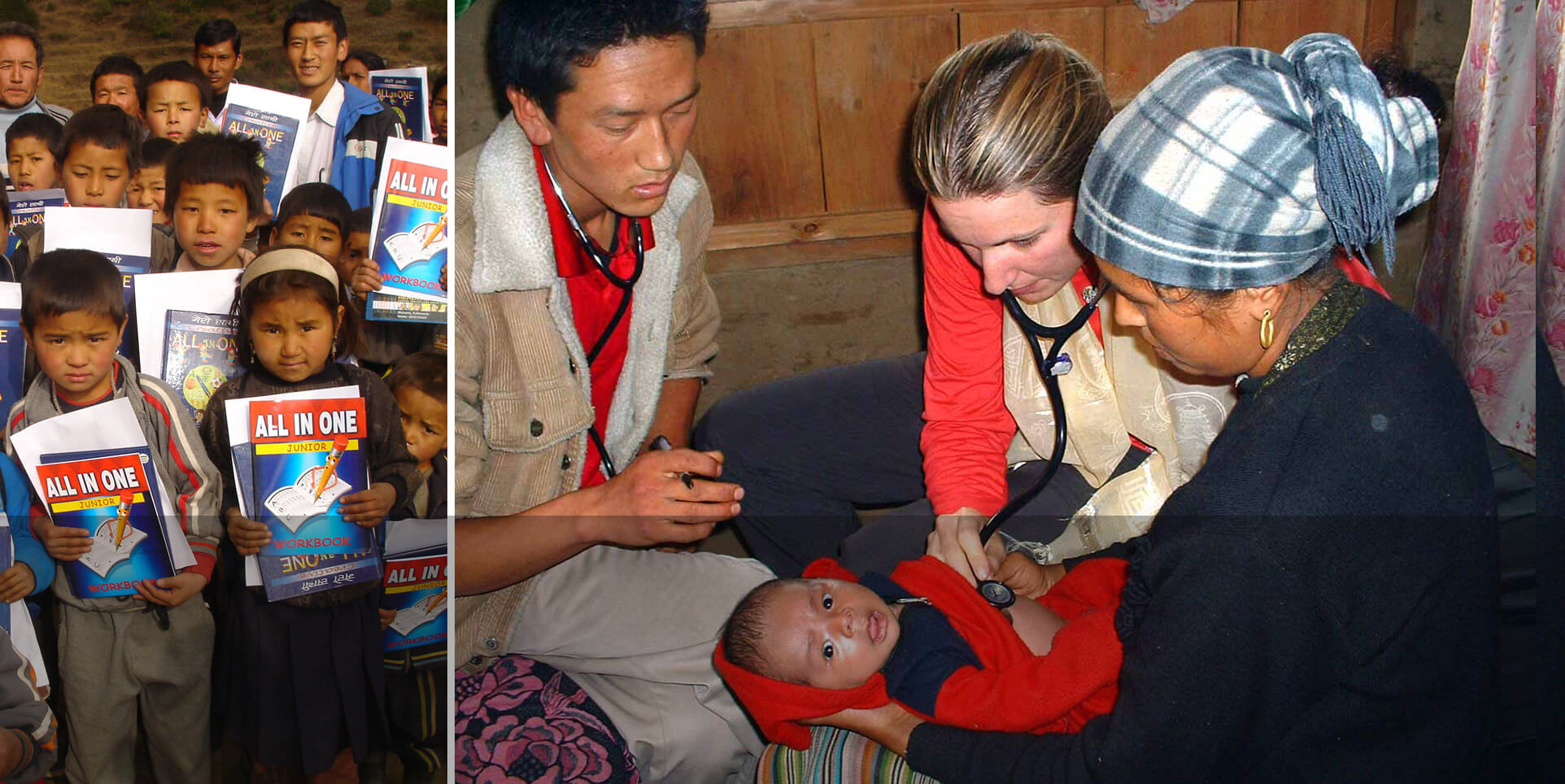
Our team brought much needed school supplies to Patale Village and are handing them out to the children in the photo. There are 3 classrooms that serve over 70 students from grades 1 through 5. The school has 3 teachers on staff and students travel here daily from as far away as a 3-hour walk to attend classes daily (Morris Prokop). One of our Service Walk members, Barbara, inside the school with the kids doing their lessons (Barbara Trenary).  Dan, Ying and Maya inside the school, clapping along to songs the school children sang for them (Elaine Smith).

Kundruke - Maidane School: This a primary school for 70 students, with 3 teachers. An active and involved school committee has kept their focus on priorities, teacher and school attendance, and the teachers at this school really seem to care. During our recent meetings with the teachers and school committee, they were very clear in their ideas for improvements that could be made, different textbooks needed, etc. Our current project involves a building upgrade and expansion with classroom floor plan reconfiguring and the addition of one classroom, to replace one classroom which was very cold and damp and the students do not wish to sit in as they catch cold. In addition, we will be expanding the school ground to enlarge the play area to a size large enough so that the children could play volley ball and games. back to top

Also the stairway to the bathroom needs to be improved.  We have estimated the total costs of improvement at around $1800, 1400 euro, 1200 pounds. All of the land and much of the labour and materials will be donated by the local villagers. We are interested to hire new teachers in the future, and hopefully opening up the new classroom will help encourage an attendance increase so that hiring a new teacher can be justified.

Dhaurakharkha School: this school has 150 students and 5 teachers but needs a lot of help and sadly exemplifies a lot of the issues that are facing Nepal. An under motivated school committee has begun building two more classrooms, but student and teacher attendance flagged recently when the construction of the classroom ceased for more than 7 weeks. We visited the school last week and found that only 1 teacher had shown up and was trying to teach 60 students on his own. After our visit, the town council met to discuss the situation and concerned parents agreed that they would call an election next month to choose a new school committee, finish the construction, and get the teachers and students to show up. We told them that when the school resolves its problems, more support will be coming in terms of classroom upgrades and additional teachers. The parents were pleased and said they would try to speed up the replacement of the school committee.


Students at Chhermading School with Dave, Brian and Jackie in the back row. We added a new building, and hope to have 6 more teachers and class 9 and 10 be taught at the new school with the help of generous sponsors (Dan Mazur). 

Kiji Bazaar School and District Headquarters: we have been visiting this "larger" village for several years and have developed a strengthening relationship with the School district administrator here who supervises 41 schools, including the three schools mentioned above. Not only are his offices located here, but also a 12 class higher secondary school, which is one of the best schools in the district. The administrator has asked for books (novels, reference, and magazines) in English language to be given to the school library. If anyone knows how to bring such books inexpensively, please let us know as shipping from overseas is quite expensive. A computer center is currently under construction and the administrator has asked us to give 5 laptops. They don't have to be new, but must have at least 500mb of ram and contain at least a 20gb hard drive. If anyone knows where we can get the laptops, please let us know! we can easily arrange shipping to Nepal from either Bristol, England, or Seattle.

Service Trek Members Purchase School Books: In Brilliant news, 2012 www.ServiceTrek.org members Peter Thornton, Inge Hove Nielsen, and Mitch Campbell Purchased 500 colourful English/nepali reading/arithmetic textbooks to send up to the Kundruke-Maidane and Dhaurakharkha schools. Well done and thanks for your educational assistance to the people of rural Nepal, so that they can learn how to help themselves. For your information, a textbook costs just $2, 1.5 euros, or 1.3 pounds. back to top

School administrator shows off the library at Kiji Bazaar, 50 books and so many more are needed. Who wants to help? (photo DL Mazur). Deha and Jangbu accept delivery of 120 kilos of books, before loading on bus roof top to be taken to the village by porters (photo DL Mazur).

Classroom upgrades: for 2013, we have decided to implement a new program of classroom upgrades for all of the schools to include sustainable local-sawn wood panels for the walls and ceilings, concrete floors, new desks, and whiteboards at the front of every classroom. The cost to upgrade one classroom is just $300, 250 euros, or 200 pounds.

Health care news: on our recent November service trek, visiting casualty/emergency doctor Brian Rolson saw 89 patients in 2 days. Please visit www.ServiceTrekNews.org to hear what he has to say about health conditions in our Dhaurkharkha health post with new Charmading village satellite health post. The health post is staffed by three health workers, and it costs about $14, 10 euros, 9 pounds a day to run the two clinics which includes health worker wages, building rent, and medicines.

Big news: Dhaurkharkha is getting a new health post. It will be built during 2013 at a cost of $1800, 1400 euro, 1200 pounds. All of the land and much of the labour and materials will be donated by the local villagers. We are very excited about the new health post as it will include 4 rooms: 1 women's exam room, 1 men's exam room, 1 kitchen, and 1 overnight stay room. Its going to be a very big step as we had been doing everything in only 1 small room up to now.

Continuing Education for health workers. As this health post is the only one in the district and serves an area encompassing a total population of 6,000 to 10,000 people, we find it is extremely important to keep our health workers well trained up on the latest techniques and medicines and always expending their knowledge base. In this vein, Dati Sherpa, a 21 year old girl from the village, has completed her 2 year Associated Nursing Medicine certification, has done three months of maternity and infectious disease training and is now about to embark on an intensive maternity training course at the nearest large hospital, in Okhaldunga town. Our hope is that Dati will be able to take over at the health post. The cost for her 13 months of training and last years associated expenses is $1000, 750 euros, 650 pounds. For 2013, after Dati returns to the health post, our next goal is to send health worker Jamyang Sherpa to earn his 2 year certificate and become a Certified Medical Assistant. We estimate the cost of this programme to be $3000, 2300 euros, 2000 pounds which includes all living expenses, tuition and books for 2 years. back to top

Patale health post worker Jamyang and Dr. Lisa McClellan examine a Nepalese baby (Murari Sharma).  A view from above of our camp and the Dhaurakharka health clinic (Chu Trandinh). The Patale health post before the doors were opened, Jamyang sitting at his desk (Murari Sharma).

Family Planning: the birth rate in the village is currently skyrocketing.

60% of people are under age 40 and 40% below 20 years of age!

we have a generous sponsor named Ms. Kharis Fausset who is concerned about family planning and helping the villagers to stem the tide of the birth explosion which is sweeping Nepal at the moment.

Due to Ms. Fausset's support, we have fully stocked the health clinics with condoms, birth control pills, and depo shots. In addition, we have been working on a short simple video to discuss the issue. Additionally we have been working with the village elders to implement community action groups, including the women's groups, school committees, and a new family planning committee being formed in the village. Many thanks for your interest in this extremely important family planning issue to try and reduce the rapidly exploding population growth in Nepal.

Pediatrics specialists needed: doctor Rolfson has issued a call for Pediatrics specialists, either nurses, physicians assistants, or doctors, to visit the village as he feels there may be a number of childhood illnesses and congenital childhood conditions which need the attention of a specialist. back to top

2. Cultural Preservation News: we strive to help the people of Nepal maintain their culture. Thanks to the great work of Marcia MacDonald at the Deboche Nunnery, we worked for a month with 16 locals to bring running water to Nepal's oldest convent, built in 1925. the project involved carrying 1500 metres, nearly a mile of pipe up to 4100 metre, 13,500 foot high Deboche Convent. Our team of hardworking sherpas constructed a concrete tank at the base of a distant waterfall and dug lengthy ditches to install the pipe and bring it to the convent kitchen. The nuns are able to draw water whenever they like now, instead of having to carry buckets on their heads over icy trails. For more information, please see www.MEFnews.org

 Deboche nuns returning from a trip to town. MEFSD director Murari Sharma and national park ranger Kharkhi supervising the workers digging in the pipe for the Deboche waterline project (Dan Mazur).

3. Environmental news: we strive to maintain the environments we visit and are working hard to work with local nepalis to maintain and repair their environment.

Biogas project: we are working hard with a team from a group called Engineers without Borders to help the people around Mount Everest treat their waste and do it in such a way that they are able to make the waste into sanitary crop fertilizer, while simultaneously producing useful methane gas which can be captured and used for cooking fuel or generating electricity.

biogas metring and filtering insruments, icimiod.JPG cooking with biogas, icimod.JPG
Biogas metering equipment. Photo: DL Mazur. Cooking on biogas in a university kitchen. Photo: DL Mazur.
 
With the assistance of Mingma Sherpa, Garry Porter, Mike Sullivan, Ryan Gilbert, and KP Cloos, we made a visit to 5300 metre, 17,500 foot high Everest basecamp to study the project and are now in the design preparation phase, working together with the engineers and local villagers to produce a design that works for everyone. For more information, please see  www.MEFnews.org

Water quality: we studied water quality around Everest basecamp, with the help of Sonya Remington and Jon Kedrowski. We have ascertained that the main water source in the nearest village to basecamp, known as Gorak Shep, may be polluted. We plan an extensive water quality study during 2012. For more information, please see www.MEFnews.org . back to top

Please send in your feedback about our new website, as we are always trying to improve the charity/non-profit information and wish to say hello to those who visit. Thanks! back to top