Projects You Can Support Through the Mount Everest Foundation -
Please click one of the links below to view projects the Mount Everest Foundation is supporting or just scroll down: Dhaurakharka Schools: we visit and teach in these schools during our Remote Nepal Service Walk . The village of Dhaurkharka in Patale district has 2 primary schools that educate children in classes 1-5. One school, on the banks of the Patale Khola river, actually in the village of Maidane, has around 60 students in class 1-3. Above Dhaurkharka village, on the trail to Taur village, the other school has 70 students in classes 1-5. We are hoping to receive funding to add 2 new teachers and bring more school supplies like books, paper and pencils. A primary teacher earns around $100, £60, €70 per month. School supplies are best purchased in Kathmandu and carried by porters to the village. $200, £120, €135 would purchase enough pens and paper for one of the two school’s students for 1 year and pay for their transport from Kathmandu to the village. The students at both schools are in need of book bags, which cost around $5, £3, €3 each in Kathmandu.
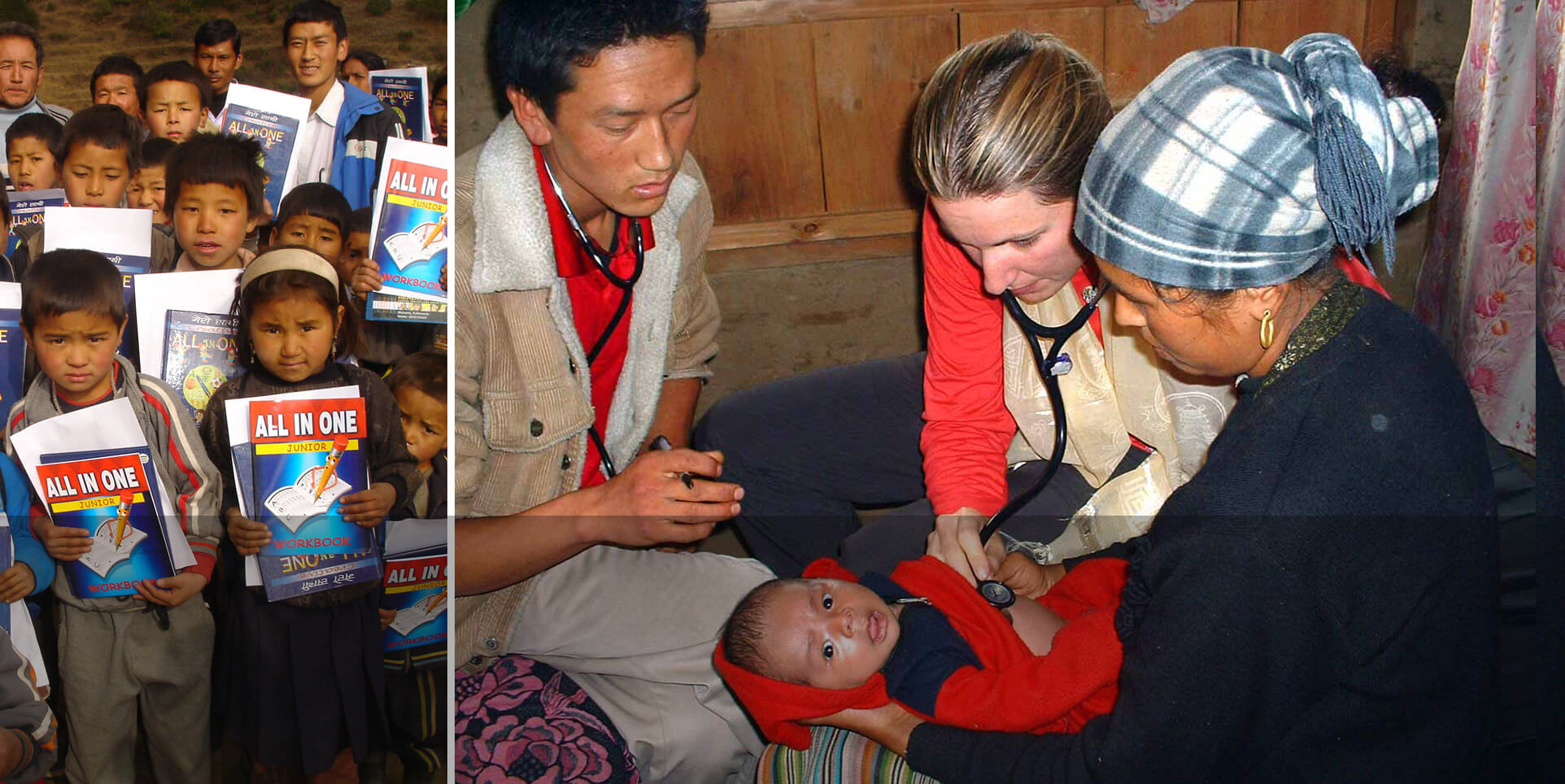
Our team brought much needed school supplies to Patale Village and are handing them out to the children in the photo. There are 3 classrooms that serve over 70 students from grades 1 through 5. The school has 3 teachers on staff and students travel here daily from as far away as a 3-hour walk to attend classes daily (Morris Prokop). One of our Service Walk members, Barbara, inside the school with the kids doing their lessons (Barbara Trenary). Dan, Ying and Maya inside the school, clapping along to songs the school children sang for them (Elaine Smith). Chhermading school: we visit and teach in this school during our Remote Nepal Service Walk . 700 people live in this small village and they don't receive many foreign visitors, if any. Their school has 300 students of ages 4-18 and goes up to class 8. These students walk from all over Patale District, which comprises 6000-10,000 people (population statistics in Nepal are inexact as there is no official government cencus). The Chhermading School currently has 8 teachers. We met the members of the school management committee. They are very keen to make an addition to their school and add classes 9 and 10. This would make their school the only high-school in the district and enable students to take the school-leaving-certificate exam, a college entrance requirement. Currently such students have to walk 1 day to the nearest high-school, a hardship for the students and their families, who are seldom able to afford boarding costs, in addition to the difficulty of separation from their young children. For this reason, it seems few students in Patale district complete high school. During our meeting with the school officials, we agreed to try and locate funds for the new school buildings, supplies, and teacher’s salaries required. A government permit is required at a one-time cost of $1500, £900, €1000. Land acquisition, building construction materials and labor costs will amount to $2000, £1200, €1350 and the additional 6 teachers needed to instruct the extra 80 students who are expected to attend will cost around $150, £90, €100 per high-school teacher, per month. back to top
 Students at Chhermading School with Dave, Brian and Jackie in the back row. We hope to add a new building, 6 more teachers and class 9 and 10 to the school with the help of generous sponsors (Dan Mazur).
Dhaurkharka Health Clinic: we visit and examine patients in this clinic during our Remote Nepal Service Walk . - The clinic has been active since 2004. During our November 2009 visit, we trekked around the neighbouring villages and learned that this is the only health clinic in the entire district of Patale, which now has a population of 6000-10,000 people. There is no government census here, so figures are inexact. We need to continue funding expenses for worker's salary, ongoing education, worker’s accommodation, clinic-rent, maintainance and upkeep, and most importantly a steady supply of good quality medicines. Salary for 1 health worker for a year: $100, £60, €70 per month. Education for 1 worker for a year (including their tuition, books and uniform, room and board, stipend, and travel expense) costs: $1800, £1100, €1200 per worker (Pasi: prenatal care, birthing classes, postnatal care), (Jamyang: pharmacy school), (Dati: residency at a hospital and prenatal care, birthing classes, postnatal care). Worker’s housing and food: $100, £60, €70 per worker per month. Clinic rent: $90, £55, €60 per month. Maintenance and upkeep of building including purchase of beds and furniture: $500, £300, €350 per year. Medicines: $250, £150, €175 per month. We have decided to usher in a new phase of remodeling at the Dhaurkharka health post. Here is the remodeling project we envision: - A. Render (plaster) and paint the walls.
- B. Waterproof the floor and put linoleum on top.
- C. Put more glass in the windows so more natural light can come in.
- D. Install more wires and light bulbs so there will be four lights.
- E. Hang a permanent privacy curtain around a bed in the corner where patients can be examined in privacy.
- We imagine that the cost of this project will be around $900, £550, €600 and we are seeking foreign volunteers to assist in the installation.
NOTE: Special extra funds for purchase of Depo Provera injections are needed. The government has a big difficulty supplying the "free" ones. While we are waiting for the "free" depo shots, more babies are being conceived. We want to slow down the birth explosion in Patale and the depo shots seem to be the easiest way. They cost $4, £2.50, €2.75 each. Our health clinic staff estimate that 100 ampules are enough for 1 year. back to top
Patale health post worker Jamyang and Dr. Lisa McClellan examine a Nepalese baby (Murari Sharma). A view from above of our camp and the Dhaurakharka health clinic (Chu Trandinh). The Patale health post before the doors were opened, Jamyang sitting at his desk (Murari Sharma). New health clinic branch office in Chhermading: Pasi, the Dhaurkharkha health care worker, has agreed to consider opening a new, smaller health clinic in the neighbouring village of Chhermading (where 700 people live), where she would work one day a week. It would be at her mother and father's home, and her parents have generously agreed to the idea. Hopefully we will find funding for this soon as well. We calculate the additional cost of a one-day-a-week clinic for a year of extra staff wages, room and board expenses, medicines, and rents to be around $1100, £675, €750. back to top Chhermading village with 93 houses and approximately 700 citizens. The school is the long building on the ridge (Dan Mazur).
3 girls training to become teachers for Dhaurkharka schools: we visit these students and meet with their teachers during our Remote Nepal Service Walk . The village schools never had a teacher who was a local citizen. Thus far, teachers have always come from far away districts. This has been a problem due to language and cultural difference between teachers and their students. Not to mention the likelihood that teachers would “run away home” as soon as they were paid, rather than show up at the schools and teach as they were supposed to. In order to increase the “sustainability” and accountability of the local education system, the MEF has decided to foster the education of three local girls, so that they might become teachers. back to top
The three girls from Patale who wish to become teachers, Mingma, Yangie and Kandu are in attendance at the high school in Khinji Phalante. When we visited recently the girl's teachers told us the girl's performance is "moderate", which might be considered "poor". Not surprising, as this is their first attempt at high school education and their parents have had little, if any education. We visited the girls living abode, which is a tiny hovel under the eaves of an abandoned looking village "hotel" 30 minutes walk each way from Khinji Phalante, the village where the girls high-school is located. It's far from the high school. We decided they should move closer to the school so they can have more time to focus on their studies. Also, we decided these girls need after-school tutoring so they can do the remedial work they need to improve their performance in school, develop good study habits, etcetera. These are things that are sorely lacking after their many years of school non-attendance in the village due to years of political disturbances and threat of kidnapping that left their families feeling it was unsafe to send their daughters to school. Fortunately, nowadays those problems are gone and the region is entirely secure and safe so that anyone, whether locals or tourists, can move about freely without worries. Thanks for helping us obtain funding for their tutoring, living expenses in the village, education costs and school supplies. We wish to set aside enough funds to pay for five years of schooling for each girl. Student’s food and accommodation: $100, £60, €70 per month per student. Books and uniforms: $135, £80, €90 per student per year. After school remedial tutoring: $30, £18, €20 per student per month. back to top ForEverest.org:
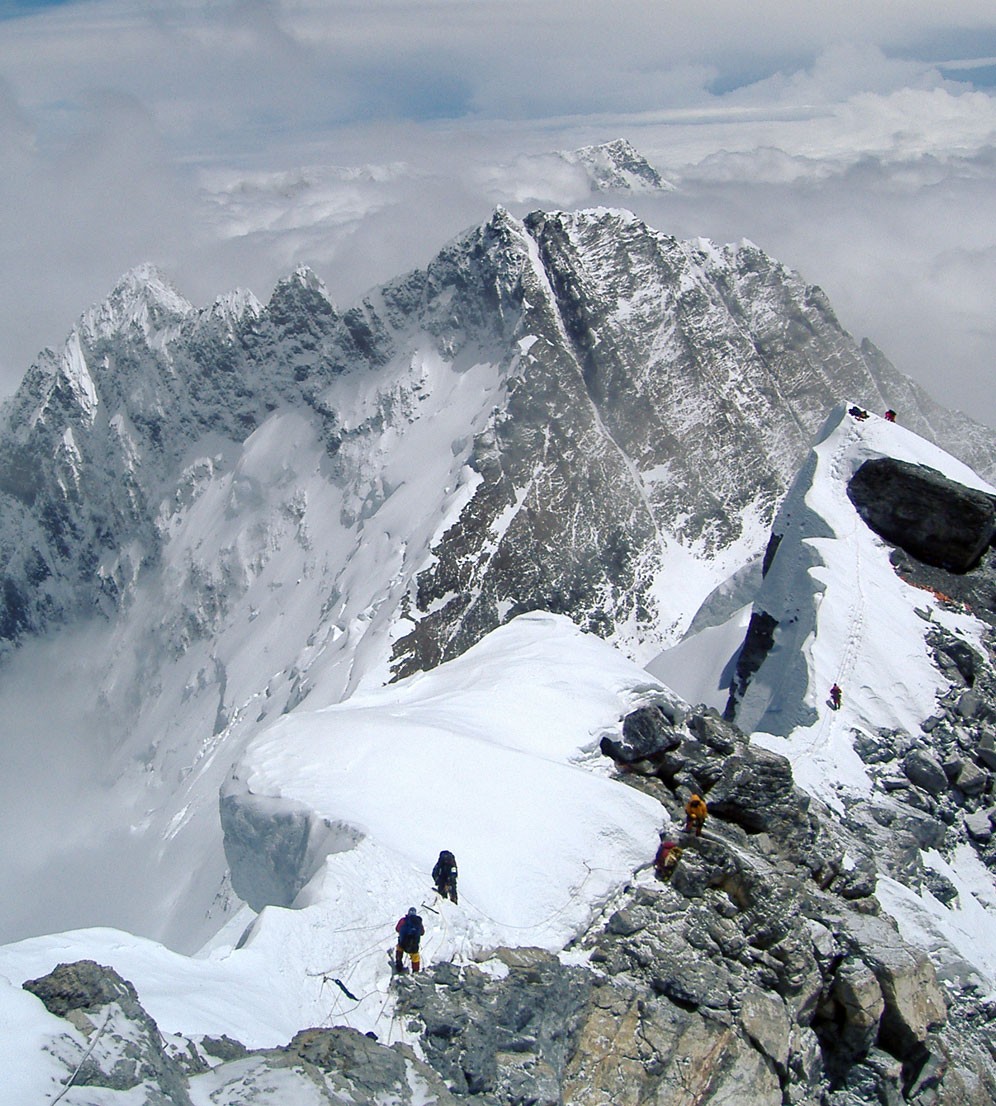
For hundreds of years Mount Everest has been a symbol of endurance and purity, but recent history has earned the world’s tallest mountain a new reputation: the world’s highest landfill. Over the past eighty years, thousands of foreign climbers have come to Everest to test their strength of will by climbing the highest point on earth—leaving behind an estimated 50 tons of trash in their wake. The Nepali government instituted a law in 1992 that requires a $4000, £2400, €2700 deposit be left by all climbers to ensure that they bring all non-biodegradable items back down the mountain. Still, tons of trash remain and we’re doing what we can to help.Through generous support of our sponsors, the Nepali Government and concerned individuals like you, we are coordinating a humanitarian cleanup expedition to Everest in 2010. The project will work with the Mountain Everest Foundation to remove 2000 pounds/1000 kilograms of trash from Everest. As part of demonstrating our sincere commitment, we are not planning to spend resources on individual climbing pursuits and instead, will focus on the trash to be removed. The talented and highly experienced sherpas will be paid fair wages to bring down trash from Camp 1 & 2. This strategy will not only improve the environment on Mt. Everest; but also, help support the local Sherpa communities. We estimate that removing 2000 pounds/1000 kilograms of rubbish will cost approximately $5000, £3000, €3350, or approximately $2.50 per pound/half kilogram. back to top 
The trash strewn on Everest and all over the surrounding area.
The Deboche Nunnery Project (a new destination along our Everest Basecamp Service Trek in Nepal): This project involves restoring the Pema Choling Buddhist women’s convent, also known as the Deboche Nunnery (also spelled Debouche Nunnery and Debouche Monastery), where 14 impoverished nuns live in a leaky old convent. The building is falling down, and many tourists walk past and never consider it. The nunnery was built in 1928 and it has had little or no maintenance since. The convent is the “sister-monastery” to the famous Thyangboche monastery on top of the hill between beautiful Deboche and Namche, along the Everest basecamp trek. The men who live in the monastery on top of the hill have brand new buildings with fancy paintings, indoor plumbing, solid walls and intact roofs, while the women live at the bottom of the slope in very simple (and leaky) circumstances with no running water. back to top Perhaps you might like to get involved. Please click here to see a short video about the Deboche / Debouche Nunnery & Convent made by Squash Falconer, Mingma Sherpa and Tom Grimshaw (www.tomgrimshaw.co.uk). Our current project for 2010 involves connecting a free flowing spring lying 300 metres distant rom the convent to the main kitchen building by way of a water pipe buried one metre deep underground. We seek your help to raise $1900, £1150, €1300 for materials and transport, and $1350, £825, €900 for labour. In addition, we will have a service walk to Everest basecamp and conduct the waterline project. A very meaningful way to see basecamp and help out some destitute nuns along the way. Cost for service walk: $2750, £1650, €1850.The future of Debouche Convent lies in the continued recruitment of nuns to live, study, and teach their. The MEF wants to bring forth a three-phased programme: - Refurbishment of one of the old nuns quarters into a retreat centre for foreigners to attend the convent, study and meditate. Cost: $6700, £4000, €4500.
- Refurbishment of one of the ancient buildings into living quarters for four additional nuns: $3800, £2300, €2550.
- Repairs and maintenance for the 17 buildings on site, which are in a constant state of disrepair, including the need for new roofs, interior walls, wooden floors, glass windows, etc.: $2400, £1450, €1600. back to top
A view of the Deboche Nunnery and surrounding valley (Marcia Macdonald). Nuns made a special prayer ceremony wishing good luck to our team at the Deboche Nunnery. Ani Dolma, Mia and Squash enjoying making new friends at the Deboche Nunnery (Dan Mazur).
Please send in your feedback about our new website, as we are always trying to improve the charity/non-profit information and wish to say hello to those who visit. Thanks!
Thanks for becoming involved with charitable giving, donation, philanthropy and contribution to the Himalaya and charity non-profit volunteer service work, helping local people help themselves to build hospitals, schools, environmental, and cultural preservation projects. back to top |