"I personally felt the trip was very well organized and executed. I was very impressed that you cared enough about the anchors and ropes to fix them properly. Most other expeditions seemed to not care and were willing to use whatever was currently in place."
Here is what Stein from Norway had to say about our October 2007 expedition:
"Regarding the expedition I have only praise for you!! The new web site is very good and feedback from family and friends says that they were able to follow the expedition very closely!! BZ! I have no hesitations in recommending this trip to anyone. All in all I am very satisfied with the trip!!"
Here is what Wanda, Ama Dablam summitter who has been on climbs with other companies has to say:
"What I liked best about this expedition was the focus of independence that was placed on each person. I have been on other "guided" climbs and I never felt like I was gaining much in the ability to become a self-sufficient climber. On this trip, I felt good about the knowledge and confidence that was gained, knowing that I had to take care of myself as well as look out for those on my team. I especially liked they way everyone climbed at the rate that best suited their own fitness level. I never once had the feeling that I was waiting for someone to catch-up or that I was holding up the team.
There are a couple of things that I feel individuals can do to make this trip an enjoyable experience.
1. Train! I have always found that the more fit I am, the more I enjoy any expedition. Also, research the route and come prepared with the knowledge of what to expect.
2. Come with a relaxed, open mind. The team dynamics on my Ama Dablam trip were great because there were no stringent agendas (personal, or otherwise) I have found that it is the less uptight people that generally have the best experience and now that I think of it, the reason the Ama Dablam trip was free of this aspect was probably because of the personalities of the leaders. They are serious about why they are there, yet it is approached with a "no worries" attitude. I LOVED THAT! And it obviously worked, because every member of our team summitted.
Because we had many Sherpa on our team and we interacted a lot during the climb, I felt this was a cultural experience as well. Many spoke a little English so we were able to converse, ask questions about their lifestyle and customs. They were an integral part of our expedition, hard working and very experienced. I was glad to have had this interaction as it gave that much more feeling to an “international” endeavor.
My concern about any problems in Nepal I heard about before the trip were non-existent in the areas we traveled. We did not witness any such disturbance. Traveling as a single female, I am probably a little more cautious than most but I have to say that never once did I feel concerned about my safety.
Looking back, if there was one thing that I would suggest to make this trip better it would be more yak cheese pizza at basecamp! Yum, this stuff was delicious.
Overall, this company gets top marks for their operation and that is why I will definitely climb with them again in the future."
Here is what Bjorn from Norway had to say about our October 2007 expedition:
Thank you for a fantastic trip! I'm safely back home, already back at work!
Regarding your expedition, all I have is praise! Things very generally well organized, however provided enough slack to allow a lot of personal preferences. Everyone in the staff were good people, the climbing sherpa's were strong and the kitchen staff made great food and took good care of us.
Impressive staff, and I would like to mention the climbing sidar, Kagi, as a person who made lasting good impressions.
I also felt that the schedule of the trip regarding the trek in, acclimatization and duration was good, and well thought out.
Thank you for a great adventure, a spectacular summit, nice people and staff and fantastic weather."
Here is what Joanne from Birmingham, England had to say about our October 2007 expedition:
"First and foremost I have to thank you for warming my toes in camp 3 and suggesting swapping my layers around - I'm sure I couldn't have gone a step further if you hadn't helped with the defrosting exercise!!
I really enjoyed the trip and the whole group were great fun to be with. Considering how large the group was, and a number of concerns about this were raised amongst the group, the ascent groups were pretty well organised.
The meals were pretty darned good considering logistics, supplies and camp locations. The lighting was excellent in the mess tent. The cooks were great and so polite and hard-working in all camps.
I was really impressed with the sherpas - Lakpa and Tenzing were great!
Great to have a shower tent and a ladies pee tent (these were about the only places where there were no peeing men in view!!)
Looking for the next mountain to climb!"
Here is what summitter Eric Elliot had to say about our October 2007 expedition:
"Strictly speaking, this was an "unguided" expedition. However, there was always some "guidance" prior to and during this fantastic expedition. Before my trip, SummitClimb answered many questions that I had by email, clearly and in a timely fashion. What's more, during the expedition, the leader and his excellent Staff, assistant leaders, and extremely competent Sherpas were always available to explain technique and offer assistance to ensure the best possible chance of success.
This does not imply that minor improvements can never be thought of for a very comprehensive, well-coordinated and well-established expedition with optimal flexibility, but everything detailed on the excellent website was accomplished and so nothing more could be expected. Thank you so much! - for your thoughtfulness right from the start, and for sharing your extensive experience with the entire group throughout."
These photos were taken on our recent successful Ama Dablam expedition where we put 12 members and 5 Sherpas on the summit in all safety. Photos in Ama Dablam slideshow: Chris Kinny, Dan Mazur, Guan-Jang Wu, Joanne Goodson, Tom Lannamann, Scott Darsney, & Valerie Hovland. For caption information, please visit our Ama Dablam photo gallery.
Our expedition features rock and ice climb training, Sherpas, hotels, domestic flights, basecamp, yaks, porters, ropes, tasty meals on trek, in basecamp and high camps, group climbing equipment, tents, radios and satphones.
Leader: Dan Mazur , 5 Succesful Ama Dablam expeditions.
2011 expedition success: 10 out of 11 members on the summit.
Climb Asia`s most famous technical but climbable rock, ice, and snow peak.
We help you buy and rent inexpensive mountain climbing, trekking, hiking, and walking gear, equipment, clothing, boots, shoes for sale, purchase and hire at affordable, cheap, low prices.
Trek to base camp on snow-free paths through green terraced villages, rushing rivers, suspension bridges, lush forests, stay in civilized `teahouses` and camp in verdant meadows beneath towering peaks.
Stay in our comfortable basecamp, located on a warm and green grassy plain.
Dates and Cost:
10 October to 7 November (29 days in Nepal).
Flexible dates: We also offer the option to begin and the trip anytime between 10 October and 1 December.
NEW LOW PRICE!: Full Service Cost: $5950, £3650, €4550; Basic Climb Cost: $2450, £1550, €1850. Currency conversions 21-Feb-12.
Please click the logo for payment options including credit card, cheque, bank transfer, etcetera.
Recent news: Our recent Ama Dablam Expedition has just returned from a fun and successful expedition. Please click here to view news of our expedition.
Please click one of the links below to view that section of our introductory information or just scroll down (photo right by Dan Mazur: The SW Ridge route up Ama Dablam with all 3 high camps marked).
Introduction: Our expedition offers an opportunity to climb this challenging semi-technical rock-ice-snow climb, technical but accomplishible, with an experienced team, at an affordable price. We have organized nine previous expeditions to Ama Dablam (6,812 metres/22,349 feet), so our leaders and staff are very familiar with the climb.
Our proposed schedule allows for a careful and safe ascent, as well as multiple full descents to basecamp.
The style of climbing is cautious and well-timed, with excellent leadership, organization, Sherpa climbers, `walkie-talkie` radios, satellite telephones,cooks and waiters, tasty food, the best equipment, individual tents for each member in basecamp, a full kitchen in basecamp, advanced basecamp (ABC) and in camp 1, two camps on the mountain, 1000s of metres of fixed line, hundreds of rock, ice and snow anchors, top-quality high altitude tents and high altitude stoves, expedition mix gas, and full safety equipment: medical oxygen, gamow bag, and extensive medical kit (photo right by Rick Coleman: Leader Doug Sandok and Mor Doron approaching the Grey Tower at 6050 metres/19,800 feet. The route follows the right-hand snow ramp).
Our expedition features one of the most beautiful treks in the world included in the cost.
This expedition maximizes experience gained over 9 prior Ama Dablam expeditions with a strong record of reaching the top of our world`s highest peaks. In addition to more than 25 Himalayan expeditions we have an intimate knowledge of the Nepalese officials who regulate the permit system, liaison officers, sherpas, cooks, yak drivers, and hoteliers/restaurateurs. back to top
Leader and staff: In Kathmandu, during the trek, in basecamp and ABC, and on the climb, our experienced staff is with you all of the way. Our helpful climbing sherpas are some of the best. They are real high-altitude star-performers and very friendly. Our western leader is a highly experienced, friendly, and well-organized professional with multiple ascents of Ama Dablam. Skillful basecamp, ABC and camp 1 cooks prepare delicious, fresh, tasty food and hot drinks at least 3 times a day.
On trek: Our western leader, together with friendly and helpful sherpas, cooks and local people leading yak caravans carry all of your personal equipment, group equipment, and set up camp each day, prepare and serve delicious meals, so you can relax and enjoy the trek. You do not need to carry a heavy rucksack during the trek (photo right by Tom Lannamann: Two friends from DAV Summit Club on a granite step we traverse just before climbing into the couloir on the grey tower).
Our comfortable basecamp: Our cooks and waiters will serve you delicious meals in our dining tents.
On the mountain: Our western leader and group sherpas will fix the route and set up high camps, as well as carry group equipment, such as tents, stoves, etc. If you wish to help out, we welcome you to do so, otherwise just relax and focus on getting well acclimated and achieving your goals. You do not need to carry a heavy rucksack during the climb.
Sherpas: We have many group sherpas to help the team. For an additional expense, we can also provide personal sherpas and climbing-guides to individual members who wish to have their own private sherpa. We now encourage members who wish to have a lighter rucksack to hire a 1/4 of a sherpa to help with high altitude equipment transport, carrying your extra weight both up and down the mountain. back to top
Everest National Park: The park covers an area of 1148 square kilometres in the Khumbu region of Nepal. This includes Mt. Everest and several other well known peaks such as Lhotse, Pumori, Island Peak , and Ama Dablam. The surrounding area is a `world biosphere reserve`. Since 1976 the park has served to safeguard unique cultural, physical and scientific values through sound conservation principles. Vegetation in the park varies from oak, pine and hemlock forests at lower altitudes to fir, juniper, birch and rhododendron woods at mid-elevations. Scrub and alpine plant communities with bare rock and glacier are found above the tree line. 22 species of rhododendron bloom during the spring (April and May) and much of the flora is colourful throughout the year. Wild animals most likely to be seen in the park are Himalayan tahr, goral, serow, musk deer, and well over 100 different bird species (photo right by http://www.americazoo.com/goto/index/mammals/420.htm: The Himalayan Tahr can grow to a metre high and weigh upwards of 100 kg).
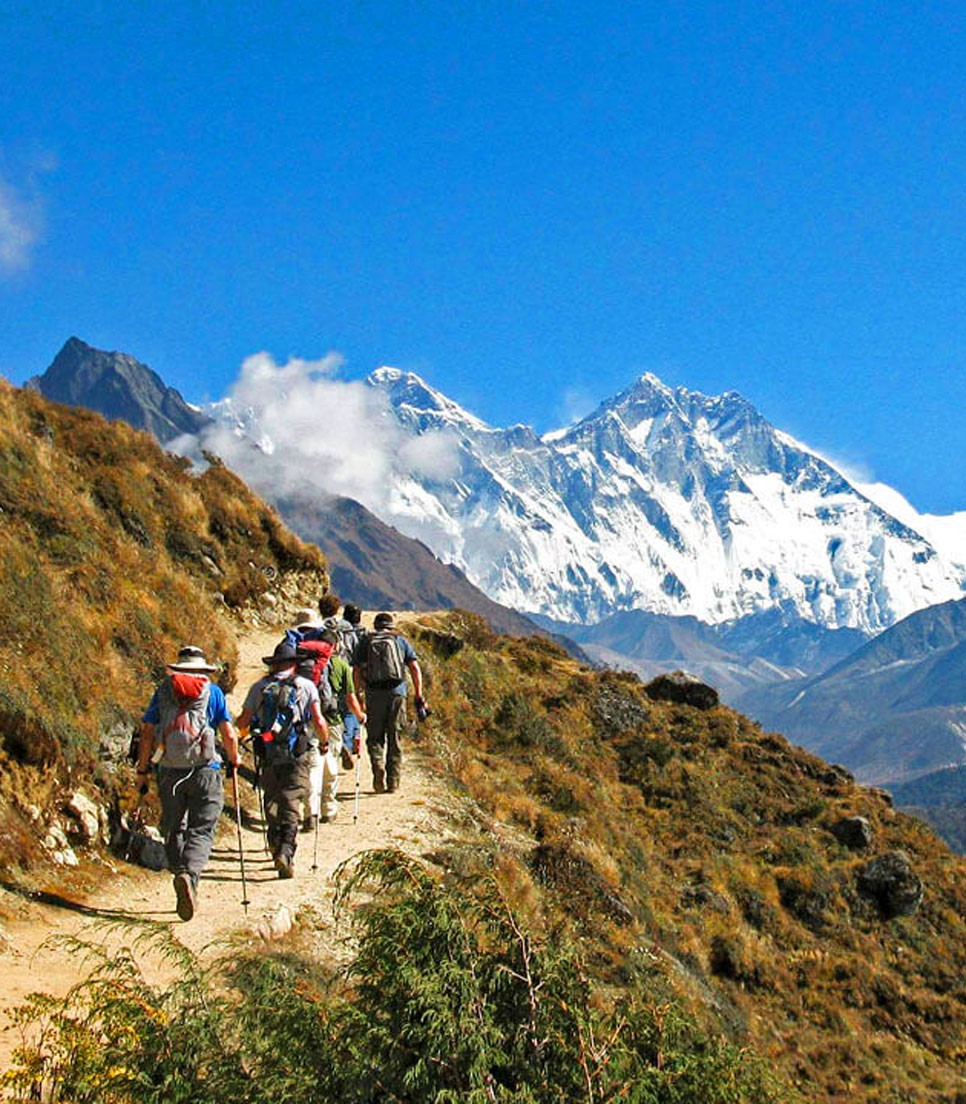
Trek to basecamp: This is one of the most beautiful treks in the world with ancient snow-free paths winding past green terraced villages, rushing streams crossed on swinging bridges and each night a comfortable `teahouse` or a good tent pitched in a quiet pasture beneath the highest peaks in the world. Throughout the trek we eat delicious meals prepared by our skillful cooks. The trek will be moderately paced, allowing plenty of time for acclimatization, rest and site-seeing. Together we retrace the classic "Everest Approach March" made by Hillary and Tenzing Norgay Sherpa. The trek winds through some of the most spectacular mountain scenery on earth, where you can relax in exotic, friendly Sherpa villages. Our trusty yaks and porters carry all of your baggage, so you don`t have to carry a heavy rucksack. Basecamp is located at 4650 metres/15,300 feet. back to top
Basecamp: Features your own private sleeping tent that will be all your own, not needing to be shared with anyone. We have comfortable dining tents with tables and chairs where our cooks and waiters will serve you delicious meals (photo right by Chris Kinny: Our advanced basecamp at 5500 metres/18,150 feet. We have a cook here who prepares hot drinks and food to keep us healthy).
Climbing to the high camps:
Base Camp to Advanced Basecampat 5500 metres/18,150 feet:Ama Dablam is one of the few Himalayan peaks that can be reached without crossing a glacier. We climb a long gravel ridge-slope, and cross a boulder field on the SW ridge where we will place advanced basecamp. There is water here in early October. Our skillful cook will be serving you hot meals and drinks in this camp.back to top
Fixed Rope: During the past 11 years it has been normal that good quality rope was fixed from camp 1 to the summit. We plan to make sure this tradition continues.
Camp 1 at 5700 metres/18,800 feet: We scramble over large boulders and climb an easy fourth class slab, where we fix a "hand-line". We establish two kitchens, complete with Nepalese cooks, in both ABC and camp 1 so you can enjoy abundant hot meals and drinks so you don`t have to cook or fill your own water bottle.
Camp 2 at 6000 metres/19,800 feet: We scramble-climb along an easy fourth class horizontal rock ridge and around several pinnacles, gaining only 300 metres/1000 feet, vertical. The exposure is huge, with massive drop-offs on both sides of the ridge. The climbing is very enjoyable with good quality granite. At the end of the horizontal ridge we climb the Yellow Tower with 6 metres/20 feet of French 4th class, British Severe, North American 5.5. Above the Yellow Tower we place camp 2 on ledges and a flat-topped rock pinnacle. Camp 2 is probably the most "airy" site you will ever pitch a tent on (photo right by Chris Kinny: Camp 2 sits atop this pinnacle at 6000 metres/19,800 feet. This photo was taken at the Grey Tower above camp 2, looking back down on the camp). back to top
Camp 1 at 5700 metres/18,800 feet. A beautiful spot to watch the sun go down on Kangtega. We have a cook here who prepares hot meals and drinks here to keep us healthy, as well as in ABC (Chris Kinny). Brewing up in camp 2 at 6000 metres/19,800 feet (Chris Kinny). Jay Ullin waving from camp 3 at 6280 metres/20,600 feet. That`s Taweche behind him. In recent years we have only used camp 3 to stop and make hot drinks and rewarm our feet (Duane Morrison).
Rest Days: We will be taking a lot of them throughout the expedition. During your rest days we encourage you to concentrate on recovering, eating and drinking, to read, relax, listen to music and stroll around visiting other teams.
Summit day: From camp 2, a steep snow ridge is climbed through the Grey Tower, with one move of French Class 4, British Severe, or 5.5, then multiple fourth class-scrambling pitches in snow, rock and ice. A snow-rock-ice chute is climbed to gain the ridge traverse, named the "mushroom-ridge", which is a very bizarre but fairly stable formation. This is followed to the right side of the base of the Dablam, where camp 3 is made on a broad flat snowfield. In recent years, due to risk of avalanche, we have only used camp 3 as a stop to make hot drinks and rewarm our feet and we have not slept overnight there.
Two easy pitches of dramatic but very solid 40+ degree snow-ice are climbed to the side of the Dablam, where is located a short 4 metre high snow-ice step tilted at a 75 degree angle. We climb a snow ridge through the fluted, but very easy and solid, 30-48 degree snowfields that lead to one of the worlds finest summits (6,812 metres/22,349 feet), where you will be treated to incredibly stunning views of the south Face of Lhotse, Nuptse, Mount Everest, Cho Oyu, Pumori, Shishapangma, Makalu, and the Khumbu Himal. back to top
Our team of climbers and Sherpas on the summit on a perfect day. You can see Nuptse, Everest, and Lhotse in the background (Chris Kinny). Paul from Southampton on the summit, in October (Rick Coleman). We were fortunate to be able to assist in the first ascent by a Nepalese woman, and putting the youngest woman on the summit. Maya Sherpa and Camille Kinny on the summit, with Everest on the right. A beautiful day, if a little windy. When we got back to Kathmandu the reporters were at the hotel and the story was printed in the paper (Chris Kinny). Joanne from Birmingham and our leader, Dan Mazur, on the summit (Joanne Goodson).
Who is this trip for?
We encourage men and women from around the world, of all ages to join us as an individual team member or with your own group, whether that is your spouse, partner, friends, sibling, clients, colleagues, etc. Most of our members join as individuals, our team dynamics work well, and we are able to build successful and safe groups that enjoy trekking, climbing, and traveling together (photo right by Wu Guan Jang: Climbers in the Yellow Tower at 5950 metres, the hardest climbing on the route, with one tricky move. We double all fixed lines here for safety).
You should feel confident climbing rock up to French 4th class, British Severe, North American 5.5, as well as have previous experience in glacier travel using ice-axe and crampons.
To participate in this expedition you must be a very fit and active winter-walker-climber in good health. Prior to joining, please see your doctor and obtain the necessary permission and advice.
Please "click" one of the links on the column on the upper right of the screen under Ama Dablam to learn more about our expedition. back to top