.


Search Box
Testimonials .

Here is what Vik from Seattle had to say:

"The leader provided great team leadership and is a very good communicator, clear and patient. I liked the independence afforded on the expedition and we had a good team. The solar charger and battery setup in basecamp worked well and the double wall dining tent and heater were nice. The sherpas were very hard working and super friendly. There were no slackers on the staff."

Here is what the Mallorys from Canada, a family of 4 Everest summiters, had to say:

"SummitClimb is very patient and well organized. On expedition the showers were nice, the toilet facilities were good, tent arrangements were comfortable, the food servers were great, the food was tasty, and we even had heaters in basecamp and doctors on the trip.

The organization was well done and we had very little concerns, with all of our requirements were met. We had a great climb with a huge deal of success.

The SummitClimb Sherpas were very supportive, capable and helped us at important times when we needed their assistance. Preparation for the climb was made easy, with all of the important information available on the SummitClimb website. Questions were readily answered rapidly by the SummitClimb office staff. Most importantly, the leader was very professional, respectful, communicated information readily, and was a key component in the success we enjoyed on Everest"

Here is what Eric from Canada, the youngest Canadian male to summit Everest had to say:

"It’s a personal accomplishment I have been thinking about for a very long time. I am very happy with the outcome. When I saw the south summit I felt confident and on top of Everest I felt happiness, excitement, and relief at being on top of the world."

Here is what Everest summiter, Sophie from France had to say;

"I think Everest is very different than any other mountains I have climbed. You have to be strong, focused, and confident to enjoy it.

I love climbing for fun. My personal sherpa was really fun to climb with and did a great job of keeping me motivated. We took it step by step together and he was with me the whole way. We stopped a lot and took breaks, shot photos, had snacks, and enjoyed the experience of climbing Everest. My sherpa let me lead about 60% of the time, which was nice because I love to leading when I'm climbing."

Here is what Phil from the UK has to say:

"The expedition is ideal for individuals or groups of climbers who wish to participate in a Himalayan expedition at a reasonable price. The price is only slightly higher than the cost of organizing your own independent expedition. You have the wealth of experience provided by the organizers and land leaders, who use no middlemen, dealing directly with the government mountaineering office.

Allows a member to experience the Himalayas a little bit as the first pioneer climbers did when there was no such thing as commercial expeditions. Some climbers without the contacts and knowledge to organize their own trip will enjoy how all logistics are taken care of by professionals, from your arrival at the airport to your departure from the staging city."

Here is what Troy says:

"Thanks for everything! I appreciate everything you did to make this a safe and successful expedition."

Here is what Bruce says:

"I thought the expedition worked well and it was another good group of people you put together. I look forward to climbing together again and seeing you next time."

Here is what Dale has to say:  

"I just want to say "thanks" for organizing this expedition. I was able to achieve my childhood dream/goal of reaching the summit of Mt. Everest, and SummitClimb was a big factor in that dream becoming a reality."  

Here is what Arnold has to say about climbing Everest from Tibet:

"It’s a full service expedition with everything taken care of. Or you can go in simple style with the basic climb. It's less expensive than the South side expedition.

It involves some very interesting history of Mallory and Irvine and the 1920s expeditions.

SummitClimb's strong team of staff and sherpas has helped fix the route to the summit many years now and they know the mountain well.

It's less crowded than the South side and there is a nice slow pace of approach and climb.

The leaders are very team focused, dedicated and hard working, with attention to the member's needs and details letting each participant go at his/her own pace with their own desired support.

The basecamp food is excellent with plenty of hot drinks.

The Tibetan side of Everest might be shorter to climb, you start from a high ABC at 6400 metres. The summit day is shorter, starting from 8300 metre high camp, 300 metres higher than high camp on the Nepal side."

Here is what Amer had to say:

"Please know that i am truly delighted and 100% satisfied with my SummitClimb experience! Everything went smoothly so far as the organization goes, and i am grateful to have been a part of the team."

Mount Everest Nepal Expedition Climb Route Description | SummitClimb
Route
Everest Nepal Intro
Cost
Itinerary
Route
Leadership
Your Experience & Training
Personal & Team Equipment
Questions
Photo Gallery
Video Clips
News
Application (Int)
Application (US)
Testimonials

These photos were taken on our recent expedition. Photos in slideshow: Fabrice Imparato, Dan Mazur, Bruce Manning, Roman Giutashvili, Tunc Findik and Gennady Kopieka. For caption information, please visit our Everest Nepal photo gallery

  • Full Service price includes oxygen, Sherpas, hotels, domestic flights, basecamp, yaks, porters, ropes, tasty meals on trek, in basecamp and climb, group climbing equipment, tents, radios, satphones, etcetera.
  • Leader: Dan Mazur , Everest expert: 9 Everest expeditions. 
  • 2011 expedition: 5 out of 6 members reached the summit.
  • Climb the route first ascended by Sir Edmund Hillary and Tenzing Norgay Sherpa.
  • The Nepal (south) side of Everest is warmer and less windy than the Tibet side of Everest.
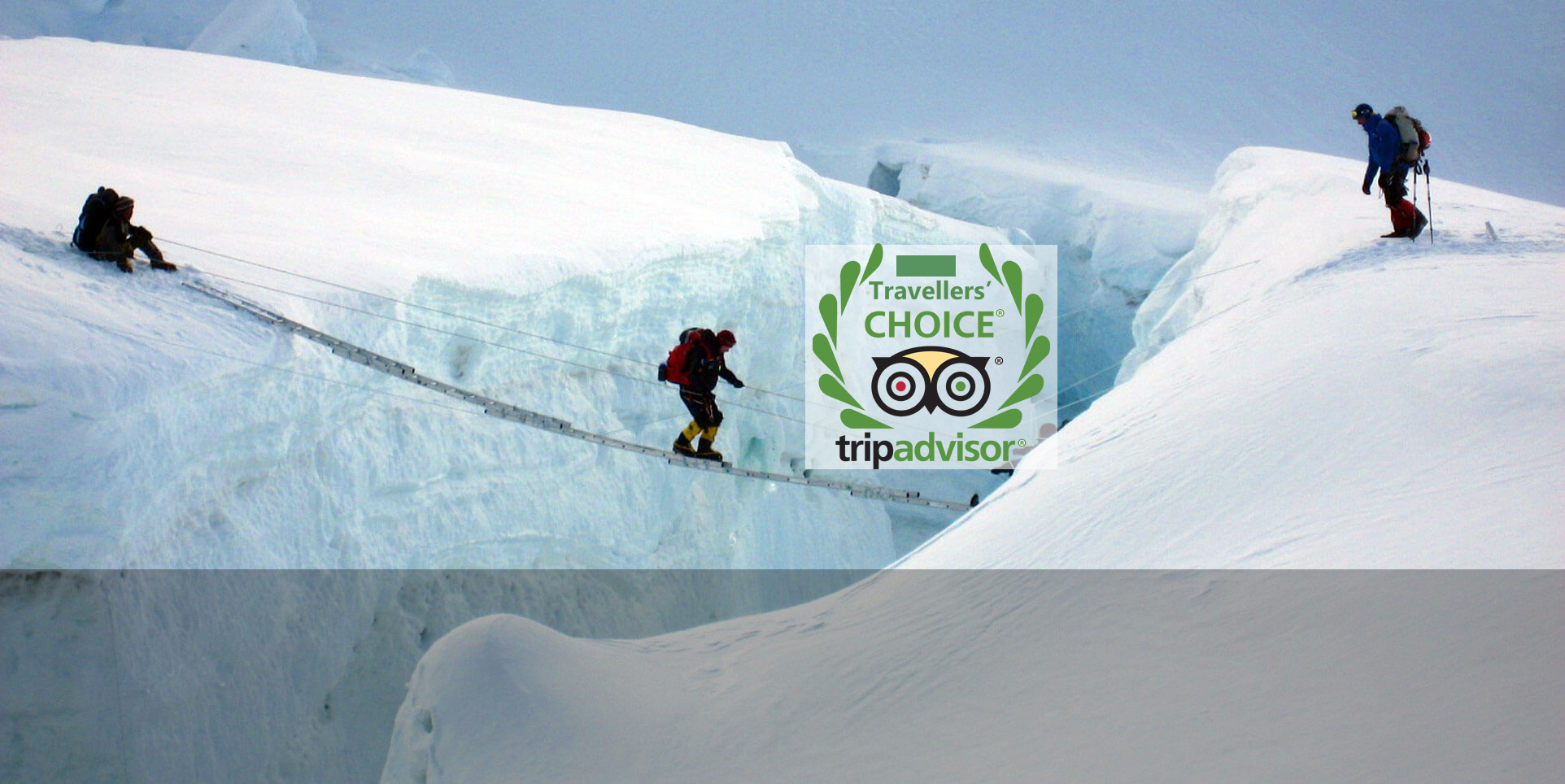
  • Cross the massive Khumbu Icefall above basecamp. Clip to well-fixed ropes on solid ladders over crevasses.
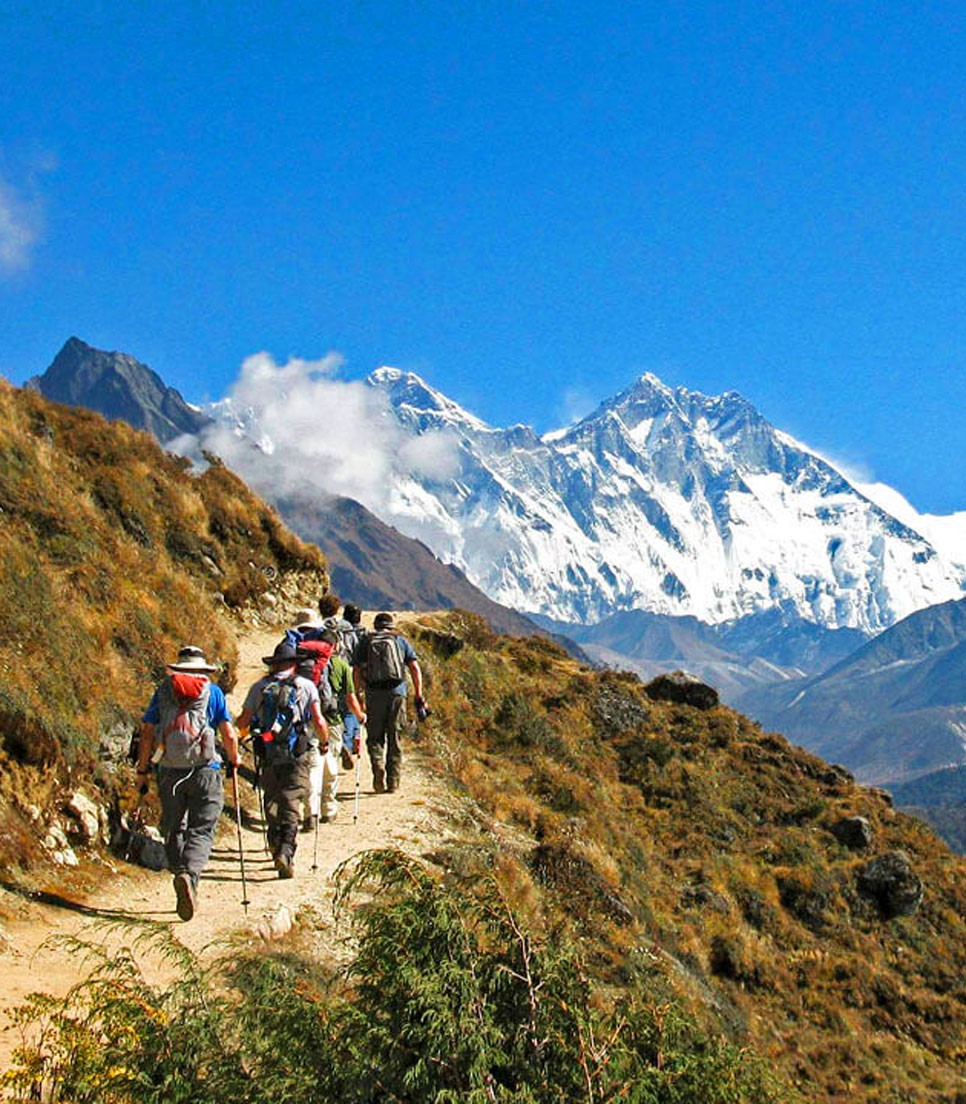
  • Trek to base camp on snow-free paths through green terraced villages, rushing rivers, suspension bridges, lush forests, stay in civilized 'teahouses' and camp in verdant meadows beneath towering peaks.
  • We help you buy and rent inexpensive mountain climbing, trekking, hiking, and walking gear, equipment, clothing, boots, shoes for sale, purchase and hire at affordable, cheap, low prices.
  • Now offering exciting Nepal to Tibet Everest traverse option. Climb one side and descend the other.
  • Not ready for Everest? Join our Everest Camp 3 Training Climb .
  • Dates and Cost:
    • SPRING DATES: 7 April to 5 June. 60 days in Nepal. Full Service Cost: $35,450, £22,450, €28,350; Basic Climb Cost: $14,950, £9450, €11,950. 
    • AUTUMN DATES: 20 August to 20 October. 60 days in Nepal. Full Service Cost: $44,950, £28,450, €35,950; Basic Climb Cost: $24,950, £15,750, €19,950. Currency conversions 21-Nov-12.
    • Please Click Here
    • Please click the logo for payment options including credit card, cheque, bank transfer, etcetera.
Recent news: Our spring 2011 Everest Nepal Expedition has just returned from a successful climb on the mountain. Please click here to view news of our expedition. Please also view our "Archived News" for more stories of past trips.
 
Please "click here " to watch "Everest South Side Summit Success" a very good 10 minute film by Stewart Edge.
 
Please click one of the links below to view that section for the route on Everest Nepal, or scroll down.
Introduction-

Everest is perhaps the most coveted mountain in the world. The south (Nepalese) side is the route first climbed by Tenzing and Hillary in 1953, and the dates we have chosen feature the best weather of the year. Our proposed schedule allows for two potential summit attempts.

This expedition to Everest maximizes many years of accumulated wisdom of the high Himalaya, a strong record of reaching Everest, K2, Kangchenjunga, and many other 8,000 metre summits, along with an intimate knowledge of the Nepalese officials who regulate the permit system. We must also give credit to the highly experienced and hard-working climbing sherpas, cooking and office staff.

Itinerary-

The proposed itinerary allows enough time for proper acclimatization, rest days, and several returns to base camp, where the kitchen and base camp staff can look after all of your needs, and quell your appetite. The weather at this time of year is normally quite good and stable. However, we all know the global weather is changing, and in case of storms, you will note the proposed itinerary includes extra days as well. In previous expeditions, half of those who reached the summit needed every single "extra" day.

Weather-

At low elevation, the temperatures can vary from 27°c to -7°c ( 80°f to 20°f). At higher elevations, the temperature can vary from 16°c to -23°c (60°f to -10°f). The wind is the most chilling factor, and can be quite variable, with everything from a flat calm, to hurricane force on the summit. There may be deep snow, heavy rains, mosquitoes in wet areas, blowing dust, burning heat, bright sunshine.

Arriving in Kathmandu-

The trip begins in the ancient and colorful city of Kathmandu, and the staff will personally meet your flight at Tribhuvan airport. You stay in a comfortable, simple, clean hotel, and sample some of the tasty Nepalese, Tibetan and Western-Style cuisine, at minimal expense. During our free day in Kathmandu, we shall finalize arrangements, and take some time out for trinket hunting, with planned visits to explore the 17th century splendors of the Monkey Temple, the Durbar Square and old Kings Palace, as well as the ancient city of Patan. back to top

Trekking to Basecamp-

Early the following morning we fly to Lukla at 2,850 metres/9,400 feet., where we meet our yak drivers, and porters. If there is time, we will trek to Monjo (2,650 metres/8,700 feet), and spend the night. For our full-service members, the cost of this expedition includes one of the most beautiful treks in the world. For more information and photos, please visit our Everest trek section of the site: Everest Trek.

Trekking in the Khumbu valley. Yaks carry our gear (Bob Rowe). Crossing a bridge under rhododendron forests. (DL Mazur) Our team in basecamp (DL Mazur).

We will continue our trek up to Namche Bazaar (3,450 metres/11,300 feet), the capital of the Sherpa Kingdom. Here we rest for a day to acclimate, then proceed up to Deboche (3,750 metres/12,300 feet) for a night, then to Lobuche (4,950 metres/16,200 feet), where we have another acclimatization day. Finally, we make the last trek to basecamp at 5,300 metres/17,400 feet.

Climbing Everest-

After resting, organizing, and training in basecamp for a day, we will begin our climb. We start with a day hike through the awe inspiring Khumbu Icefall, followed by a trip to the plateau of the Western Cwm, for our first glimpse of Camp 1, at 5,800 metres/19,000 feet. We return to basecamp for a tasty dinner, prepared by our skilled cooks. back to top

Anatoly Bukreev and Vladimir Balyberdin at basecamp. (DL Mazur). On the South Col of Everest (Gennady Kopieka)

Climbing at 8,400 metres/27,600 feet above the Kangshung Face (DL Mazur).

High Camps-

Through the following weeks, we will climb up and down the mountain, exploring the route, establishing camps, and carefully and safely building our acclimatization level.

From camp 1 at 6,000 metres/19,700 feet, the route traverses the flattish bottom of the Western Cwm, to 6,200 metres/20,300 feet where camp 2 is located.

Camp 3 is on the head wall of the Lhotse face at about 7,200 metres/23,600 feet. To reach camp 3, we must negotiate the Lhotse Face. The Lhotse face is a steep, shiny icy wall. The face itself is not extremely technical, but is arduous considering the altitude increase. It gets less difficult as acclimation continues through the weeks going up and down between camps. back to top

Diane in the icefall (Dan Mazur). Tent lashed to its platform in camp 3 at 7,200 metres/23,600 feet (Dan Mazur)Climber in the Lhotse Face (Scott Darsney). Chris Shaw on the face at 8,100 metres/26,600 feet, during an early summit attempt (Dan Mazur)

The South Col, camp 4, is the highest camp and at 8,000 metres/26,200 feet, it is a windy and cold place. We take our time, climbing up and down to acclimate, which gives us the best chance to ascend in safety and maximize our opportunity to reach the summit during the "weather windows" which generally open in May. There are typically snow on the ledges to walk down on, interspersed with rock, along with some fixed rope. There’s a little short slope on reliable snow which leads to the top of the Geneva Spur. The route turns hard to the left onto the snowfield that leads to the top of the Yellow Bands.

Summit Day-

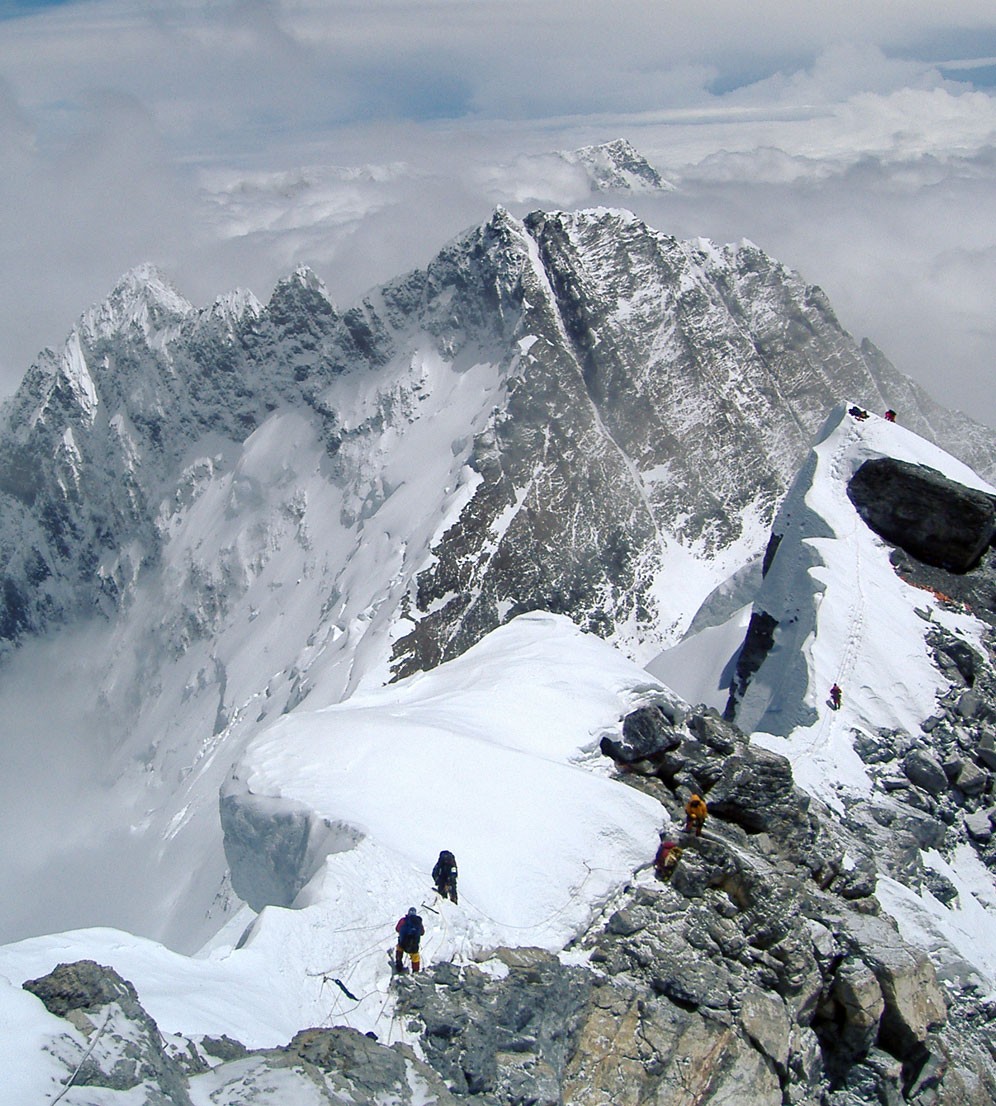
The route to the summit winds through snow ice and rock fields, at a 10 to 50 degree angle. These slopes are not considered technical, but there is exposed rock here in the spring, and lines are often fixed. Fixed rope is often placed on the small vertical pitch of the 12 metre/40 foot, high Hillary step, and the summit lies directly above. The summit sits at the top of the world.

Truly the most classic route on the world's most classic mountain. Welcome to our team! Our proposed itinerary allows for 2 possible summit attempts. back to top


Looking up at the summit from the south col. Climbing at 8,400 metres/27.600 feet, above the Kangshung Face. Approaching the Hillary Step.
Climbing on the Hillary Step (DL Mazur) .


The view from the summit, looking west to Cho Oyu, Shishapangma, Pumori, and many others (DL Mazur) .

Optional Everest Traverse-

We are very excited to be offering a traverse of Everest. There are two ways to do it, from Nepal to Tibet, and from Tibet to Nepal. We are able to offer both options as we have expeditions from both sides. If you are interested in doing this, please contact us as soon as possible.

From the summit, you will cross over and ascend the other side of Mt. Everest where camps will already be established from our Tibet expedition.

For more about the route coming down from the summit on the Tibet route, please click here. For more about the cost of doing the traverse from Nepal to Tibet, please click here.

Descending the fixed lines below the summit on the Tibet side (Ryan Waters).

Going Home-

After packing up all of your equipment, supplies, and rubbish, you will make the return trek to Lukla. The following morning, you are up early, and fly back to Kathmandu, where you can enjoy a hot shower and a grand Nepalese western-style feast. In Kathmandu, you can have a day to relax, celebrate, tour the valley, write postcards, and do a bit more shopping, before heading home. We hope you had a safe, enjoyable, and successful adventure. Thanks for joining in! back to top

Thank You for joining our Everest Nepal Expedition.